What to Expect from Dyscalculia Tutoring: A Parent's Guide
You have done the hard work of getting a diagnosis and finding a specialist. Now you are wondering what actually happens next. What does a tutoring session look like? How long will this take? What is your role as a parent?
These are exactly the right questions to ask, and this post answers all of them so you can walk into the process with clear expectations and confidence.
What a Typical Session Looks Like
Dyscalculia tutoring sessions at Exponential Potential are 45 minutes long and follow a consistent, structured format. Consistency matters because students with dyscalculia benefit from knowing what to expect. It reduces anxiety and allows them to focus their energy on learning rather than orienting to a new environment each time.
Sessions often begin or end with a math game that reinforces the concept being reviewed or introduced. This is intentional. Students with dyscalculia frequently arrive with a complicated relationship with math, and a positive, playful experience during the session helps build a different kind of association with the subject over time.
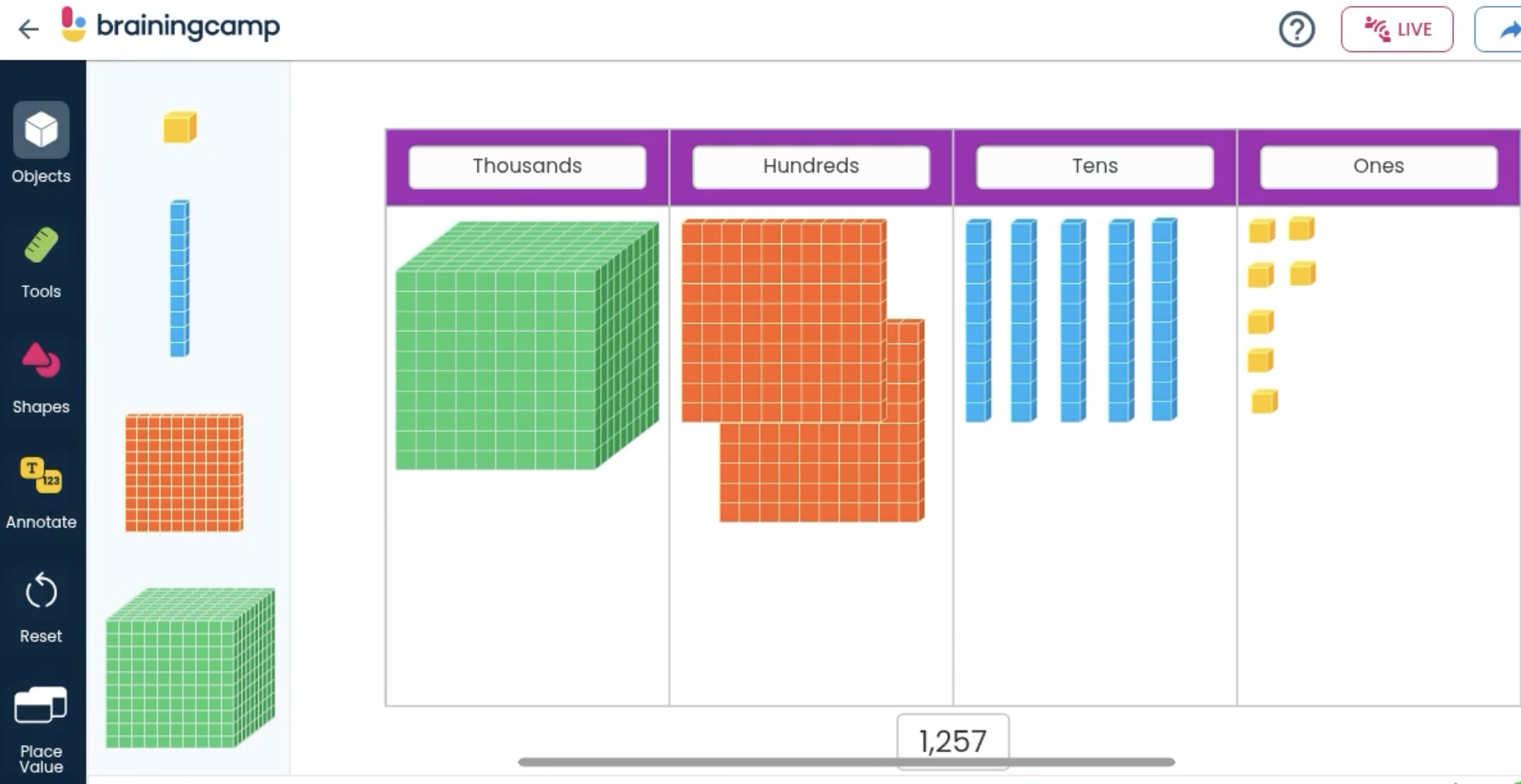
The core of each session involves targeted CRA instruction. The tutor begins with a brief review of concepts from the previous session to reinforce and reconnect with material before introducing something new. At the concrete stage, the student works with physical or digital manipulatives to build a hands-on understanding of the concept. This might look like building numbers with base 10 blocks, exploring multiplication with an area model, or using Cuisenaire rods to understand fractions. Once that understanding is solid, the tutor guides the student in representing the concept visually before moving on to abstract symbols and equations.
We also conduct periodic general math assessments to track progress and identify skills that still need attention. These assessments help ensure that instruction stays targeted and that foundational gaps are not being overlooked as new concepts are introduced.
How Online Tutoring Works
All of our sessions are delivered online through Koala Go, a platform designed specifically for educational tutoring. Parents are often surprised by how well dyscalculia tutoring translates to an online format, and in some ways it is more effective than in-person work.
Koala Go includes a co-browser feature that allows the student to interact directly with digital manipulatives alongside the tutor in real time, so the student is actively participating rather than just watching. Document cameras on both sides of the screen allow the tutor and student to work with physical manipulatives collaboratively, with each able to see what the other is doing. This means a session can move fluidly between digital tools and hands-on physical materials depending on what the concept calls for.
To participate in online sessions, students need a reliable internet connection, a device with a built-in camera, speakers, and microphone, a document camera, a small whiteboard and markers, and physical manipulatives as determined by the tutor.
How Often Should My Child Meet with Their Tutor?
We recommend twice-weekly sessions for students working to build foundational math skills. More frequent practice leads to faster progress and helps new concepts stick between sessions. Dyscalculia tutoring works best when there is regular, consistent contact rather than long gaps between sessions.
We understand that twice weekly is not always possible for every family. Work schedules, extracurricular activities, and other commitments all factor in. Once-weekly sessions can still produce meaningful progress. It simply takes longer to reach the same goals. Whatever frequency you choose, consistency matters more than intensity. Showing up regularly, even once a week, is far more effective than intensive bursts followed by long breaks.
How Long Will Tutoring Take?
This is one of the most common questions parents ask, and the honest answer is that it varies significantly from student to student.
The factors that influence duration include the student's age at the start of intervention, the severity and scope of their foundational gaps, how frequently they attend sessions, and how actively they engage in the work during sessions.
Some students make significant gains in six months. Others benefit from longer-term support spanning a year or more. What we can tell you is that dyscalculia tutoring is not a quick fix, and any specialist who promises rapid results in a short time frame is worth approaching with skepticism.
What most families notice first is not a dramatic jump in grades but a shift in how their child relates to math. Less avoidance, less anxiety, and a growing willingness to try. Those changes often come before the academic gains, and they matter just as much.
How Is Progress Measured?
Progress in dyscalculia tutoring is tracked in two ways: formally and informally.
Informally, your tutor will observe how your child engages with concepts across sessions. Are they able to demonstrate understanding with manipulatives? Are they able to move from the concrete to the representational stage? Are they retaining concepts between sessions? These observations guide instruction and help the tutor adjust the pace and approach based on what each student needs.
Formally, progress is communicated to parents through regular updates. You will not be left wondering what is happening in sessions. Your tutor will keep you informed about what your child is working on, what they are mastering, and where they continue to need support.
If your child has school accommodations, your tutor can also support communication with teachers and school teams by providing information about the student's progress and the methods being used.
What Is Your Role as a Parent?
Your role is more important than you might expect, and it goes beyond scheduling sessions and handling logistics.
One of the most valuable things you can do outside of sessions is look for opportunities to weave math naturally into daily life. Cooking together involves measuring, fractions, and doubling recipes. Home repairs and gardening projects involve measuring, spatial reasoning, and estimation. Playing math games as a family builds fluency in a low-pressure environment and reinforces the skills being developed in sessions. These kinds of real-world experiences help your child see math as something useful and manageable rather than something to avoid.

Helping your child consistently practice and use their classroom accommodations is equally important. Accommodations only help when they are actually used, and a parent who advocates for their consistent use at school makes a real difference.
We keep parents informed about their child's progress and the methods being used in sessions. You will receive regular updates on what your child is working on, what they are mastering, and where they still need support. That information belongs to you as a parent and can help you stay connected to your child's learning and advocate effectively on their behalf.
The most impactful thing you can do day to day is create a low-pressure math environment at home. This means resisting the urge to show your child how you were taught to solve a problem. Most of us learned math in an abstract way, and falling back on that approach during homework time can work against the concrete foundation your child is building in sessions. When your child is working on math at home, encourage them to reach for their manipulatives or whatever other tools and accommodations help them, just as they would in a tutoring session. Supporting their use of concrete approaches at home and at school reinforces the learning rather than creating confusion between two different methods.
Helping your child practice and utilize their classroom accommodations consistently matters just as much. Accommodations only help when they are actually used, and a parent who advocates for their consistent use at school makes a real difference.
Finally, staying in regular communication with the tutor matters. If your child had a hard week, struggled with a particular assignment, or made a comment about math that concerned you, share that information. Context from home helps the tutor respond to the whole child, not just the student they see for 45 minutes twice a week.
Ready to Get Started?
If you have questions about whether our program is the right fit for your child, we offer a free consultation to help families understand their options. There is no commitment and no pressure. It is just a conversation about where your child is and where they could be with the right support.
Schedule a free consultation →
At Exponential Potential, we specialize exclusively in dyscalculia tutoring using the CRA multisensory method. We work with students from first grade through college, online, across the US.


